

What's in Store?
An essay about malls and everything else you’re feeling.
An ice rink where the Sears was
I recently heard someone say that nothing ordinary can ever hold what you're feeling.
It's been a weird few days, weeks, months, even. And in all of this, I'm finding myself drawn toward the mall, the way you find yourself driving past your high school during a short trip home. Something unresolved pulling you back to where you left it.
My hometown mall has an ice rink now. It used to be a JCPenney, or maybe a Sears; I can't remember which one. One of those stores where you could buy a washing machine with a lifetime warranty and it meant something. That this thing would live forever and ever, and so would the store that sold it to you. You were building something that had a future attached to it.
The ice rink is fine, I suppose. I have feedback on their branding, but that's just because I grew up and moved to New York. My hometown people, my family, seem to be enjoying it just fine. But I think about standing there in the atrium and I feel the specific wrongness of a place becoming a different version of itself.
This is an essay about malls. That's what I'm telling us both.

A short man from Vienna
The mall was invented by a guy named Victor Gruen, a short man from Vienna. He came to the United States right before World War II, spent his first few years here as part of a theatrical group, then pivoted to designing stores. Make of that what you will.
The story goes that he was on a layover in Detroit when he looked around and thought the city seemed messy. Personally, I think a city isn't a city if it isn't a little frazzled. But Gruen wanted order and ease, so he got to pondering. What he arrived at was something genuinely radical for the time: a two-story, air-conditioned, inward-facing shopping center rooted at its center by a light-filled square with fountains, trees, and a fishpond. The Southdale Mall in Edina, Minnesota. I have no proof, but justice for those fish.
Here's the part worth holding onto: Gruen didn't want a shopping mall. He wanted a town square, something closer to the covered bazaars of the Middle East and the public markets of Europe — a place where people would run into each other, feel like part of something. The shopping was supposed to be secondary. A close second, but a second nonetheless.
Investors, however, had a different vision.
Malls were feeding America's new suburban population and turning out huge sums of sweet USD, and investors hoping to pull out as much as possible through short-term depreciation weren't particularly interested in fishponds. They were interested in anchor stores and incredibly sexy leasable square footage. The vision and the execution separated almost immediately, and Gruen spent much of the rest of his life publicly frustrated by what his idea had become. He called it, at one point, a "bastard child."
The first betrayal happened before most of us were born. True of many things.

Everything you need is here, and you can afford it
The first shopping mall opened in 1956. I'm not sure what anyone's supposed to do with that information other than know it. Dr. Martin Luther King Jr.'s home was bombed that year. Grace Kelly got married. My parents were, I'd have to check, probably not born yet.
What followed was a wave. Then another wave. By 1975, there were 30,000 malls in America, accounting for more than half of all retail dollars spent. The number of malls grew more than twice as fast as the population between 1970 and 2015. Consider that sort of an Orange Julius gold rush.
For a while — genuinely, actually, for a while — it worked.
The mall became the town square Gruen had imagined, even if by accident. It was where you went after school and on weekends and the Saturdays leading up to Christmas. It was where the nail salon was, and the portrait studio, and the food court where you could secure a Panda Express and a Cinnabon and the best stomachache of your life all in one go. (I'd like to take this moment to say RIP to my retainer, accidentally thrown away via food tray at Madison, Wisconsin's West Towne Mall.)
There’s something I keep turning over: in my memory, the mall was affordable. The stores were for families, old people with enthusiastic elbows, and teens sniffing lotion at Bath & Body Works. The mall was the great democratizer of aspiration. You didn't have to be rich to walk through it and feel like the world was set up right in front of you.
I've been trying to figure out if that was true or if I was just a child.
The honest answer is probably both. But the feeling was real because the stores were designed for middle America's income bracket. You could want one thing — really want it, search for it, find it — and that desire had a shape to it. A beginning and an end. The payoff meant something because the wanting had taken time. The mall taught you how to want in a way that felt completable.
That's not a small thing. That's, um, sort of everything.

The morning after
To get a washing machine with a lifetime warranty.
I'm fixated on this. The warranty's promise, extended equally to everyone who walked through the door, that this thing would be there for you. That your life was stable enough to need it there for you. That there would be a home to put it in and mornings to wake up in that home and laundry to do because you lived there, continuously, in a life that held.
The mall at its height was selling that feeling as much as it was selling eyebrow threading next to Auntie Anne's. Come in, everything you need is here, and you can afford it. The future is available to you today, and you can take it home tonight.
Childhood at the mall was the feeling that the world was legible. That it had been arranged, at least in part, with your family in mind. That stability wasn't something you had to locate and fight for alone; it was ambient and baked into the architecture. You walked in through the anchor store, and the whole place said: someone built this for you.
The middle class and the mall rose together. Neither knew what was coming. Duh-Duh-Duhhhhhnnnnn.
More than could reasonably be justified
The commercial real estate industry built too many malls. More than could be justified by population growth, retail sales, or any economic indicator that a reasonable person would consult. They cannibalized each other, spreading across suburbia like a franchise of a rapidly thinning dream.
In 2007, one year before the Great Recession, no new malls were built in America for the first time in fifty years. Which means the industry already knew, on some level, before the crash made it undeniable.
The Great Recession — a name I remain fascinated by, as though recessions come in quality tiers — did what recessions do: it sorted people. The middle class, squeezed between declining real wages and rising costs, stopped shopping at Macy's and went to Target. Stopped going to Sears and went to Costco. The anchor stores that upheld the whole structure began declaring bankruptcy and vacancies spread like you wouldn’t believe (or, you probably do, because you probably lived it).
Real estate experts have a clinical vocabulary for this. A mall with 10–20% vacancy is in trouble. Twenty to forty percent is unhealthy. Forty percent or more is dying. By 2014, nearly 3% of all American malls were considered dying. The fundamental problem, experts said, was gluttony. An over-retailed nation that had simply built more shopping than the country could sustain.
Some economists will tell you the retail apocalypse — yeah, real term alert — is a market correction more than anything, and that the phrase is misleading. These economists are technically not wrong. I just don't particularly want to hang out with them in my free time.
The malls that shuttered had been the largest taxpayer in most of the municipalities where they sat. When they closed, the tax revenue closed with them. The jobs closed. The nail salon closed. The weird Spencer's Gifts that was funny as a teenager and stressful as an adult closed. The community that had organized itself around having somewhere to go found itself without one.
We were all trapped inside stacking our Peloton classes
Yeah, we have to talk about COVID-19. Sorry!
Malls closed because we were all inside trying to remember how to hold conversations and discovering, with some relief and some horror, that we could have everything delivered. The e-commerce acceleration was so inevitable it barely qualifies as a plot twist. What it did was finish something that was already in the process of dying.
At this point, it was more surprising when a mall was open than when it had become a ghost town.
Shopping malls had been providing billions in local tax revenue annually, typically the single largest taxpayer in their municipalities. These were not abstract losses. In a very literal fiscal sense, malls had kept the lights on in certain communities. When the mall went, something structural went with it. And the stores inside that were too small to survive the overhead of a mall that no longer had foot traffic went too.

Private shopping rooms
Here’s what the mall became instead.
Elite malls, situated in high-income areas, hosting runway brands. Experiential malls with proper restaurants and IMAX and laser tag, trying to give you a reason to make the trip that has nothing to do with needing something. Planet Fitness where the anchor stores used to be, which is either genius or horrific; I haven’t decided yet. And luxury brands — expanding their footprints, curating personalized experiences, building special rooms for people who want to shop privately.
Why go to a mall to shop privately? The whole point of the mall was that it was public.
The luxury pivot is more of a replacement than a natural evolution, in my opinion. You know, since you asked. It’s a different social contract dressed up in the same building. “Today, we’re hoping to offer an emotional connection,” someone making $20/hour says with bloodshot eyes. Some board told some marketing team told some retail team that emotional connection is a service and not something that the mall wasn’t always, first and finally, about.
Is that why malls are so expensive now? Partly. It's because the stores that were affordable left or died, often in that order. Because lower foot traffic means remaining retailers raise prices to maintain profits on fewer customers. Because higher operating costs, inflation, and a shift toward luxury all get passed to whoever still walks through the door. The mid-range stores are gone. The middle class that shopped there has been squeezed into a different income bracket entirely. What's left is the high end and the parking lot.
The people who can afford today's mall were never the mall's original audience.
I keep turning over a question I can't fully answer: were things actually more affordable then, or did I just not yet know what things cost? I think the answer is yes, both — and also that it's not really about the prices. It's about who the place was built for. The mall used to feel like an extension of the family. It doesn't say that anymore. It says something conditional now, to a different kind of person.
The affordable stores left, and somehow the mall got worse and more expensive at the same time. That's just what happens when something stops being for you.
Or is that a cult
There's another version of this story.
A dead mall is an enormous piece of land, usually in a suburban area, usually with solid road access, surrounded by the kind of sprawl that makes people feel like they're always driving and never quite arriving. Some people look at that land and see an opportunity that has nothing to do with retail.
What would happen if we tore it down and built something else? Dense, walkable, mixed-use — housing and retail and employment all connected, so that you didn't need a car to get to work or the grocery store or your neighbor. Something that looked, loosely, like a town where people knew each other.
"The big design and redevelopment project of the next fifty years," said Ellen Dunham-Jones, a professor of architecture and urban design at Georgia Tech, in 2010, "is going to be retrofitting suburbia."
The dead malls aren't only a retail problem. They're a design problem, a community problem, an American-individualism-cosplaying-as-freedom problem. Shopping centers in much of Europe and Asia are largely thriving, which raises a question we don't love to sit with. Robert Putnam spent a career documenting the collapse of American civic life, the way we stopped joining things, showing up for each other’s stuff, being present in shared spaces, yada yada. Whether the mall was a symptom of that unraveling or one of the last places holding it off is genuinely hard to say.
Maybe the question isn't whether we can save the mall. Maybe it's whether we're willing to admit what we actually wanted from it all along.
I find, I’ve found, I’m working on it
I find myself living in an apartment that drains my bank account. Where the ceiling falls down and a cursed ex-lover kicks a hole in the wall for a stranger to patch up.
I find myself buying five coffee tables in three months, trying to sort out which one feels like home to me now.
I find, I've found, I'm working on it.
The mall and I are, it turns out, in the same position. Both of us are trying to figure out what we're supposed to be now. Hollowed out in certain places, with a Planet Fitness where something else should probably be.
I went back to the mall last time I was home. Through the back entrance, the one I've always used, the one that drops you directly into the food court. And the food court was exactly the same. I don't know how to explain what that does to a person — to find something that has held its shape while everything around it hasn't. Same smell. Same light. I didn't go near the ice rink. I forgot it existed.
I went to the alterations lady. She always confuses me with my mom, but she remembers nonetheless. Her work is impeccable, and so is my mom.
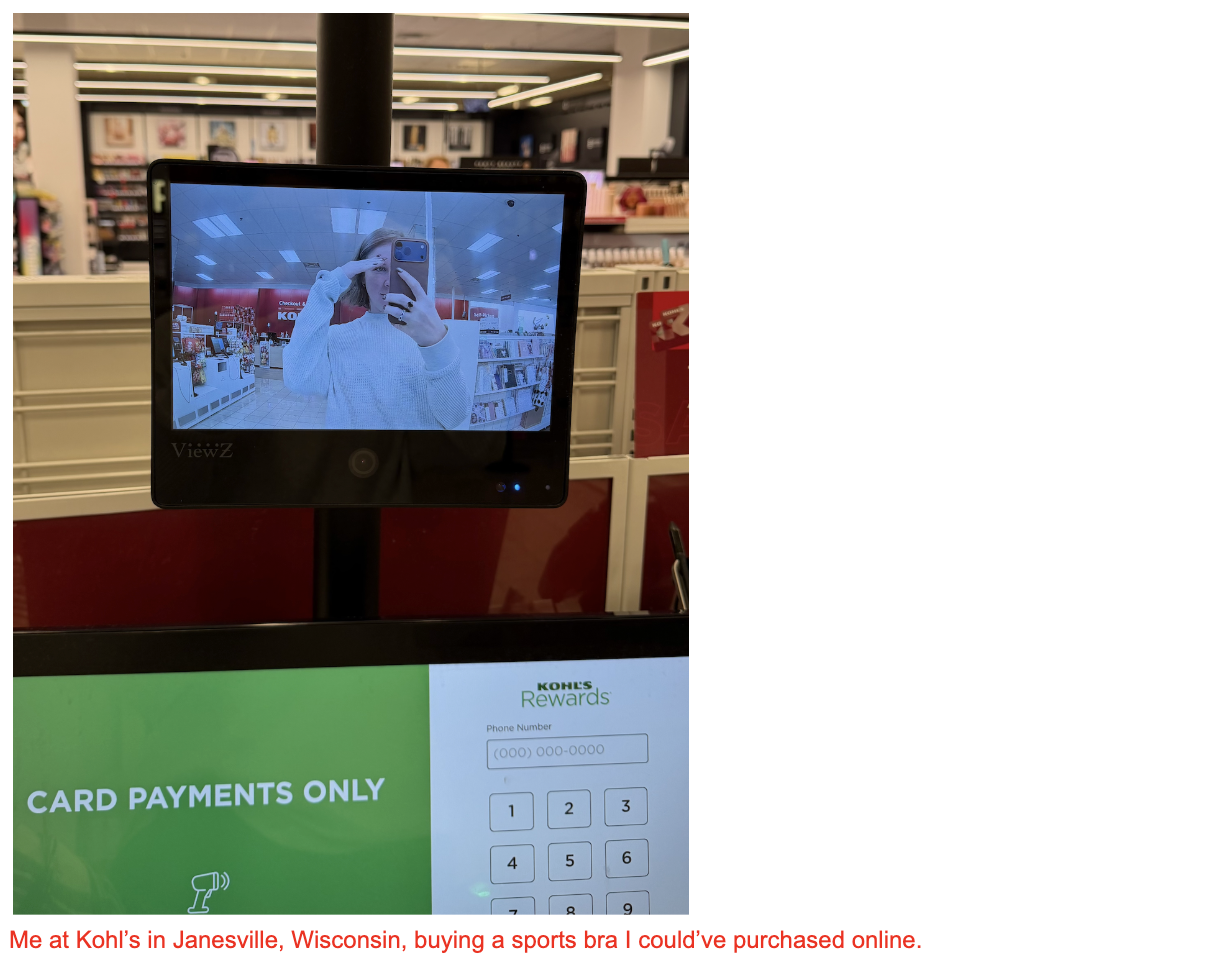
Nothing ordinary can hold what you're feeling. I do believe that to be true. But I also believe that sometimes you need somewhere to go. Somewhere that says, without much hoopla, that you can stay as long as you need.
I'm worried, by the way. But that's not meant for this.
This was about malls, and that's the way it is.
Good night, Walter Cronkite.
Sources available upon request.